

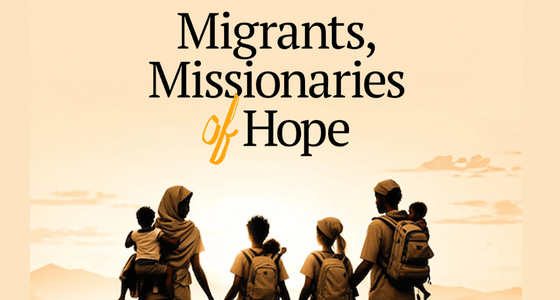
On the 26th Sunday in Ordinary Time and the World Day of Migrants and Refugees, Rev. Deacon Maximus Chongo delivered a powerful homily at St. Basil’s Catholic Church in Toronto, focusing on Social Inclusion and Justice.
He reminded us that migrants are not here to replace or displace us — they come to join us. To walk alongside us. To contribute to our shared humanity and enrich our communities with their presence, stories, and gifts.
World Day of Migrants and Refugees
Now, last Sunday, we had a great Homily on Stewardship from our Archbishop. Today, I would like to build on that homily by emphasizing:
Belonging, Belonging, And Belonging
“Say this city has ten million souls,
Some are living in mansions, some are living in holes:
Yet there’s no place for us, my dear, yet there’s no place for us.
Once we had a country and we thought it fair,
Look in the atlas and you’ll find it there:
We cannot go there now, my dear, we cannot go there now.“
(W.H. Auden, Refugee Blues)
Brothers and sisters in Christ, Auden’s haunting words remind us of a world where belonging is denied, where human dignity is dismissed, and where some are pushed to the margins. In today’s readings, the Word of God challenges us with the same reality: the tragedy of exclusion, the pain of neglect, and the call to authentic belonging in God’s household.
The problem before us today is not theology. The Church and the Bible are already rich with compelling theology about justice, mercy, and love. Rather, the issue presented in these readings is belonging. Who belongs at the table of life, and who is excluded? How do we use what we have—our wealth, comfort, privileges, positions of influence— is it for the sake of others?
Now, let us be clear: Jesus is not condemning riches or the desire for a comfortable life. Who among us does not long for stability, security, and well-being? These are good and necessary for human flourishing. In fact, the improvement of our well-being and the development of our world depend on it. Similarly, being a truly religious person is beneficial for an individual and the world at large; so too is access to financial resources. No one should be hindered in their pursuit of wealth.
What Jesus does question, however, is how we use these blessings. Are they instruments of compassion and justice, or do they blind us to the suffering of those around us? Do they foster solidarity, or do they create walls of indifference? For instance, the kind of laws we pass, the social structures we build, and the systems these laws and policies create—whether in our nation or in the global community—ought to reflect our loyalty to God, humanity, and the universe as a whole.
The Gospel paints this vividly. The rich man lives a very comfortable life every day, while Lazarus, poor and sick, lies unnoticed at his gate. The scandal here is not the man’s wealth but his indifference. His sin is not excess, but exclusion. His tragedy is not abundance, but apathy.
This echoes Amos’s bold warning: “They drink wine by the bowlful, and anoint themselves with the best oils, yet are not made ill by the collapse of Joseph” (Amos 6:6). Maybe we need to understand Amos better to appreciate today’s readings. Prophet Amos, active in the 8th century BCE during the reign of Jeroboam II, lived in a time of political stability, military success, and economic prosperity. Yet beneath the surface lay moral decline, social injustice, and religious corruption. The wealthy elites lived in luxury, while the poor were exploited. Though worship practices flourished at shrines like Bethel and Gilgal, Amos condemned them as shallow because the people neglected justice (mishpat) and righteousness (tsedaqah) (Amos 5:24). His voice resounds even today: piety without justice is an empty shell.
Isaiah, too, condemns those who chase pleasure and forget the deeds of the Lord (Is 5:11–12). Micah laments the powerful who exploit the poor (Mi 2:1–2). Together, these prophets remind us that worship without justice, and wealth without compassion, lead only to ruin.
What then does Jesus ask of us? That our fitness for heaven depends not on possessions but on relationships. It is relationship, relationship, relationship—with God, with neighbor, and with the world entrusted to us. To belong to the Triune God is to live relationally, just as Father, Son, and Holy Spirit are bound together in a communion that is not broken. To believe in the Trinity is to embrace life as communion, to compete well in manifesting our faith through mercy, generosity, forgiveness, and love.
As St. Vincent de Paul once reminded us: “You will find out that Charity is a heavy burden to carry, heavier than the bowl of soup and the basket of bread. But you must keep your gentleness and your smile. For your love must be real.” This is precisely the call of today’s Gospel.
St. Paul urges Timothy—and us—to “pursue righteousness, devotion, faith, love, patience, and gentleness” (1 Tim 6:11). This is the path of true discipleship. And Matthew 25 deepens it: “For I was hungry and you gave me food, thirsty and you gave me drink, a stranger and you welcomed me…” Here the judgment of God rests not on titles, wealth, or status, but on compassion lived out in concrete relationships.
The story of the rich man and Lazarus closes with a sober reminder: our time on earth is brief. One day, like both men, we too shall face the eternal horizon. May we not be found indifferent, blind to the suffering at our gates. Instead, may our lives echo the generosity of God, who though rich, became poor for our sake (2 Cor 8:9).
So let us live abundantly—not just in riches, but in mercy. Let us dine well—not only at our tables, but in feeding the hungry. Let us be clothed in purple garments and fine linen—but also in justice, compassion, and love.
Let us be rich men and women who enjoy the blessings of life without ignoring those placed at our doors—the poor, the disadvantaged, the marginalized. In welcoming them, we welcome Christ Himself. And in belonging to one another, we belong to God.

 English