

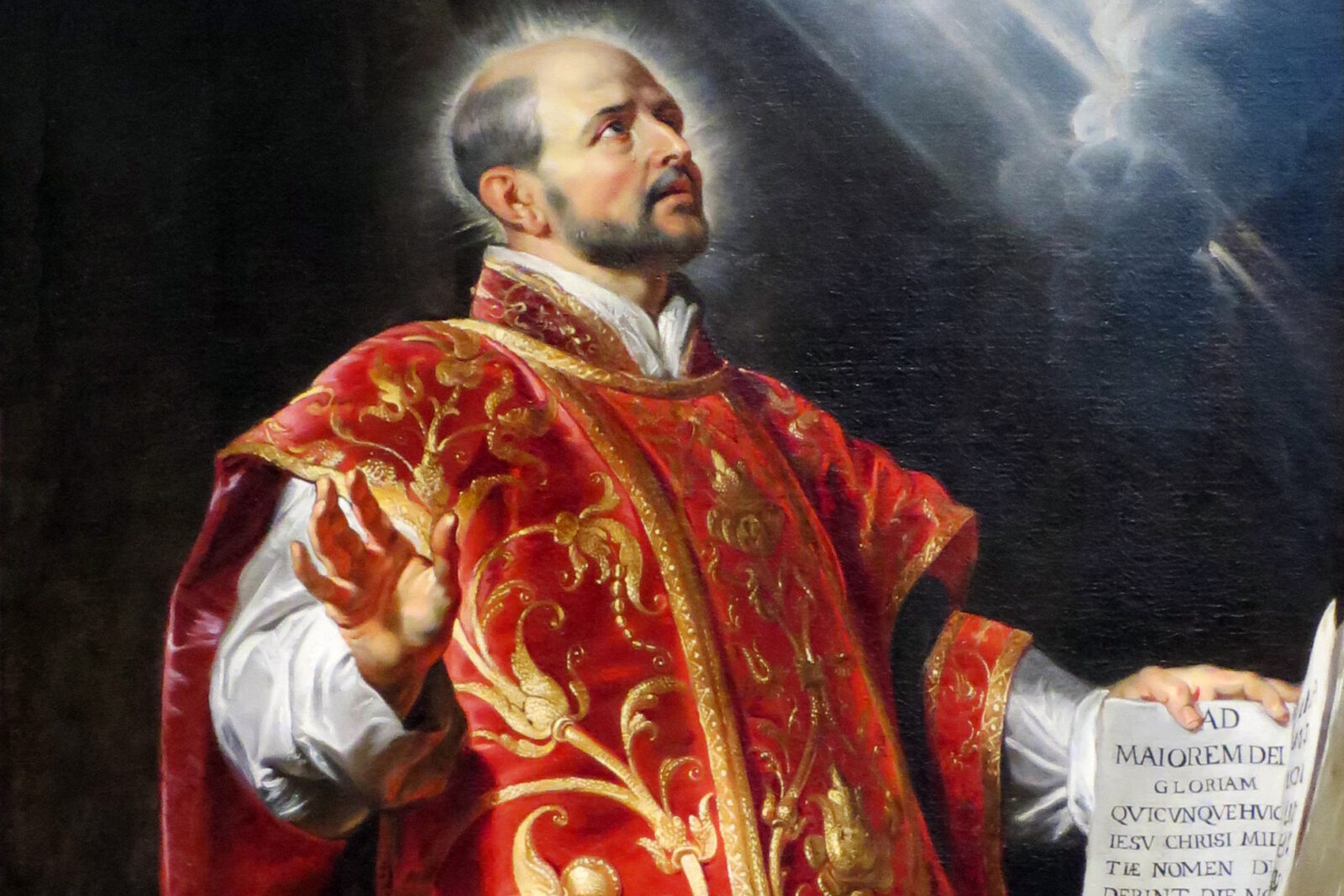
I have been reflecting about “Who is St. Ignatius of Loyola?” The temptation is to narrate his life and highlight that he is the founder of the Society of Jesus – of course that’s true. Aside from his family background, let’s take a leap to where his life took some notable transformation.
In 1521 Ignatius was gravely wounded at Pamplona in a battle with the French – what a misfortune. That nearly ended his chivalry, his military career and washed-out his self-view as a handsome young man. But it was during the period of recuperation that Ignatius experienced a conversion, thanks to two books, the Life of Christ and the Lives of the Saints. These readings and further reflection renewed in him the passion to serve, not the earthly King, but be a soldier for Christ, – these were kind of clues from God, and he acted on them.
He collected his experiences and journaled them, his insights, prayers, emotions and what came out of it was the book, the *Spiritual Exercises,* one of the most influential books on the spiritual life every written. As if that was not enough, Ignatius was impassioned to go and serve, but was limited by his lack of proper theological formation. This was not to be a barrier, so he embarked in studies, and during the studies, he gathered around a group of friends, whom he gave the Spiritual Exercises.
These were later to engage in an exercise called the Deliberations of the First Fathers in 1539, a process of communal discernment or what today we can call a synod. This was when Pope Paul III started missioning the members of this group (they didn’t have a name then, apart from Friends in the Lord), and the men gathered to deliberate on two questions – whether they should form a religious institute and if so, to choose one among them to whom they would vow obedience. Forming a new religious institute was next to impossible for two reasons:
The Fourth Lateran Council (1215) and the Council of Lyons (1272) had prohibited the formation of new religious institutes, at least not without the approval of the Holy See, else any new institutes would adopt the charism or rules or constitutions of already existing institutes (the Rule of Basil, the Rule of Augustine, the Rule of Benedict, the Rule of St. Francis, the Order of Preachers [Dominicans] who had adopted the Augustinian Rule). For Ignatius and companions, adopting the rule of an existing religious order would mean losing their initial charism and momentum. However, there is always a leeway with laws, and they capitalized on that.
At the Deliberations, call it a synod or a parliamentary debate or simply a platform to obtain and build a consensus, they agreed that it would be important to form an entirely new religious institute, and this was granted. Ignatius was elected as the first superior of the new institute, later to be superior general with the growth of the Society.
Before they drafted their Constitutions, the group developed a manual, known as the _Formula of the Institute_ was approved by Pope Paul III in 1540 by the bull _Regimini militantis Ecclesia_ this is the primary document that gave birth to the Societatis Iesu (SJ) or Society of Jesus. Ten years later, the document was revised and approved by Pope Julius III in 1550. The revised document upped the total number to a thousand men, which was easily overtaken to a high of 36,000 around the time of the Second Vatican Council (1962-1965).
So what constitutes the Jesuits? Like all religious, the Jesuits profess the three vows, that is the vow of chastity, and surprisingly, the vow of obedience [they are very obedient and ready to be missioned to other towns and cities], and believe it or not, the vow of poverty [they practically have nothing to their name as individuals]. And, believe it or not, some of the Jesuits even make another vow of special obedience to the pope.
That’s aside – Jesuits work among the people, and at times they don’t get to be noticed, rather people notice the work they do – in education, pastoral or parish work, retreat or spiritual exercises, social justice, service to the poor – nearly in every professional field, there is an active Jesuit.
These Jesuits have impacted positively in different fields, guided by the drive for the salvation of souls.
A Jesuit is a missionary,
an apostle called to excel in all he does, for the Greater Glory of God (Ad Majorem Dei Gloriam). They are called to work in the peripheries of society, in other words, missioned to “Go set the world on fire” (Ignem mittite in terram).
There are Jesuits called to ordained ministry as priests and Jesuits called to service as lay brother, and both these categories supplement each other and collaborate for the Greater Glory of God.
_Interested to know more about the Jesuits, hit the reply button and began the exciting journey_
Fr. Clyde Muropa SJ

 English